Mah-Jongg, Ancient Game of China, Is Fast Becoming Popular in America

Diversion More Fascinating Than Fan Tan Threatens to Supplant Bridge and Poker in Homes All Over Country.

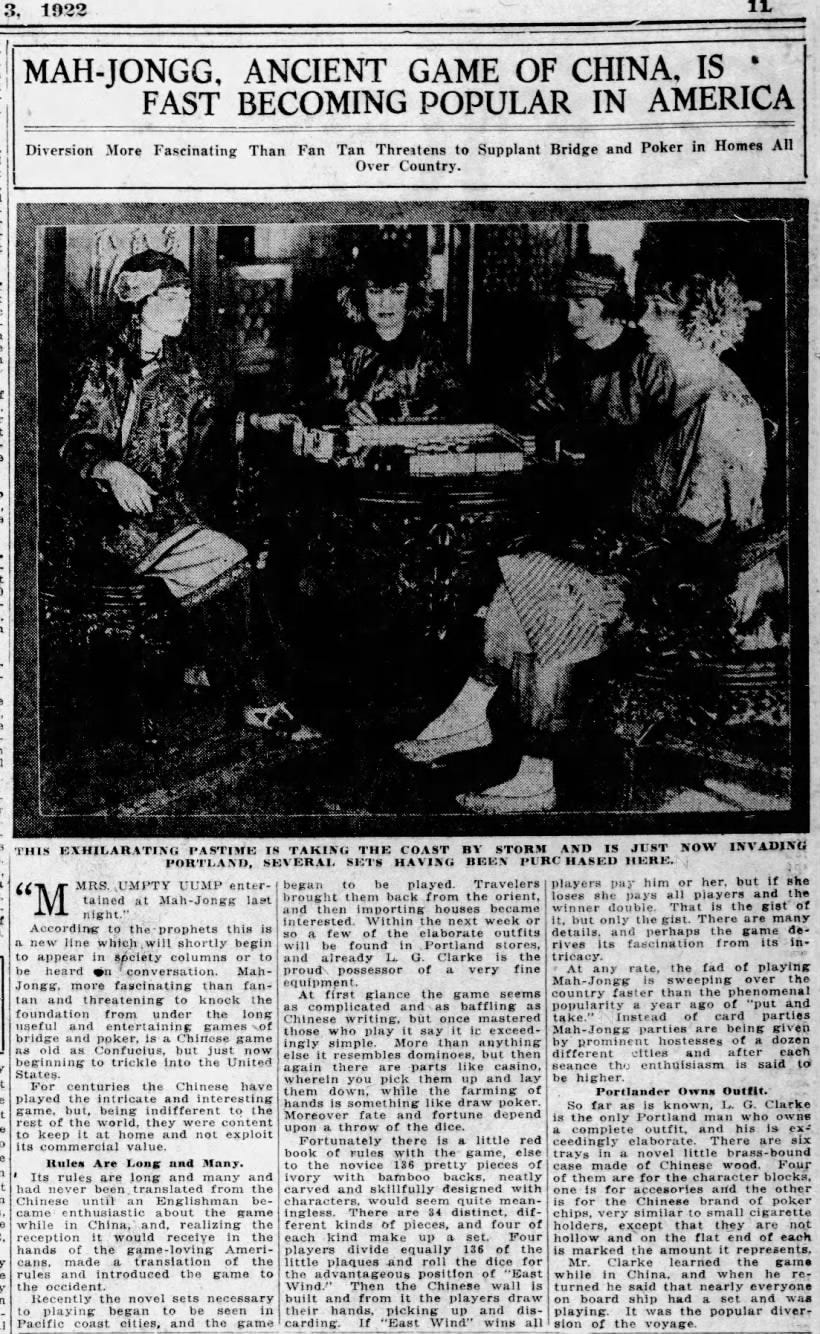
THIS EXHILARATING PASTIME IS TAKING THE COAST BY STORM AND IS JUST NOW INVADING PORTLAND. SEVERAL SETS HAVING BEEN PURCHASED HERE.

“Mrs. Umpty Uump entertained at Mah-Jongg last night.”

According to the prophets this is a new line which will shortly begin to appear in society columns or to be heard in conversation. Mah-Jongg, more fascinating than fan-tan and threatening to knock the foundation from under the long useful and entertaining games of bridge and poker, is a Chinese game as old as Confucius, but just now beginning to trickle into the United States.

For centuries the Chinese have played the intricate and interesting game, but, being indifferent to the rest of the world, they were content to keep it at home and not exploit its commercial value.

Rules Are Long and Many.

Its rules are long and many and had never been translated from the Chinese until an Englishman became enthusiastic about the game while in China, and, realizing the reception it would receive in the hands of the game-loving Americans, made a translation of the rules and introduced the game to the occident.

Recently the novel sets necessary to playing began to be seen in Pacific coast cities, and the game began to be played. Travelers brought them back from the orient, and then importing houses became interested. Within the next week or so a few of the elaborate outfits will be found in Portland stores, and already L. G. Clarke is the proud possessor of a very fine equipment.

At first glance the game seems as complicated and as baffling as Chinese writing, but once mastered those who play it say it is exceedingly simple. More than anything else it resembles dominoes, but then again there are parts like casino, wherein you pick them up and lay them down, while the farming of hands is something like draw poker. Moreover fate and fortune depend upon a throw of the dice.

Fortunately there is a little red book of rules with the game, else to the novice 136 pretty pieces of ivory with bamboo backs, neatly carved and skillfully designed with characters, would seem quite meaningless. There are 34 distinct, different kinds of pieces, and four of each kind make up a set. Four players divide equally 136 of the little plaques and roll the dice for the advantageous position of “East Wind.” Then the Chinese wall is built and from it the players draw their hands, picking up and discarding. If “East Wind” wins all players pay him or her, but if she loses she pays all players and the winner double. That is the gist of it, but only the gist. There are many details, and perhaps the game derives its fascination from its intricacy.

At any rate, the fad of playing Mah-Jongg is sweeping over the country faster than the phenomenal popularity a year ago of “put and take.” Instead of card parties Mah-Jongg parties are being given by prominent hostesses of a dozen different cities, and after each seance the enthusiasm is said to be higher.

Portlanders Own Outfit.

So far as is known, L. G. Clarke is the only Portland man who owns a complete outfit, and his is exceedingly elaborate. There are six trays in a novel little brass-bound case made of Chinese wood. Four of them are for the character blocks, one is for accessories and the other is for the Chinese brand of poker chips, very similar to small cigarette holders, except that they are not hollow and on the flat end of each is marked the amount it represents.

Mr. Clarke learned the game while in China, and when he returned he said that nearly everyone on board ship had a set and was playing. It was the popular diversion of the voyage.

Transcription note: Text follows the visible clipping; a few words may be uncertain because of the scan quality.
Mah Jongg – Tiling for Dollars. By Shelley Smokin (as seen in womenSports • February 1976 • Page 54)

1976 Tiling For Dollars

Mah Jongg - Tiling for Dollars.  By Shelley Smokin (as seen in womenSports • February 1976 • Page 54)

Mah Jongg—not to be confused with Erica Jong's mother-in-law—possesses the thrill of tennis, the accommodation of bridge, the scheming of poker, the solace of group therapy . . . and more; Mah Jongg has unique flavor and character.

Mah Jongg is an ancient Chinese game whose western enthusiasts have ranged from Winston Churchill, the Eisenhowers and Tom Seaver to Sophie Portnoy, complaining Alexander's mother.

Legend has it that a Chinese general invented the game in the days of Confucius to entertain his troops. Mah Jongg was for centuries a favorite pastime of the ruling Mandarin class. The Mah Jongg siege captivated these elite men who, in turn, hoarded the secrets of the game, forbidding play by women and the lower classes. These clandestine activities were successful until 1911 when the Republic of China was established, springing the rules, and allowing them to filter to the masses.

Still, Mah Jongg was too complicated for the western world. The intricate scoring system and elaborate rituals were not simplified until shortly after World War I, when an American resident of Shanghai, Joseph Babcock, undertook the task. He deciphered the rules and substituted English names for the varied tiles. He added index letters and numbers, then introduced his version to the west.

Even the Babcock version has its share of mind-boggling variety. Mah Jongg is called the game of sparrows—according to Chinese legend the birds of 100 intelligences. You may need to call on a flock to master this game.

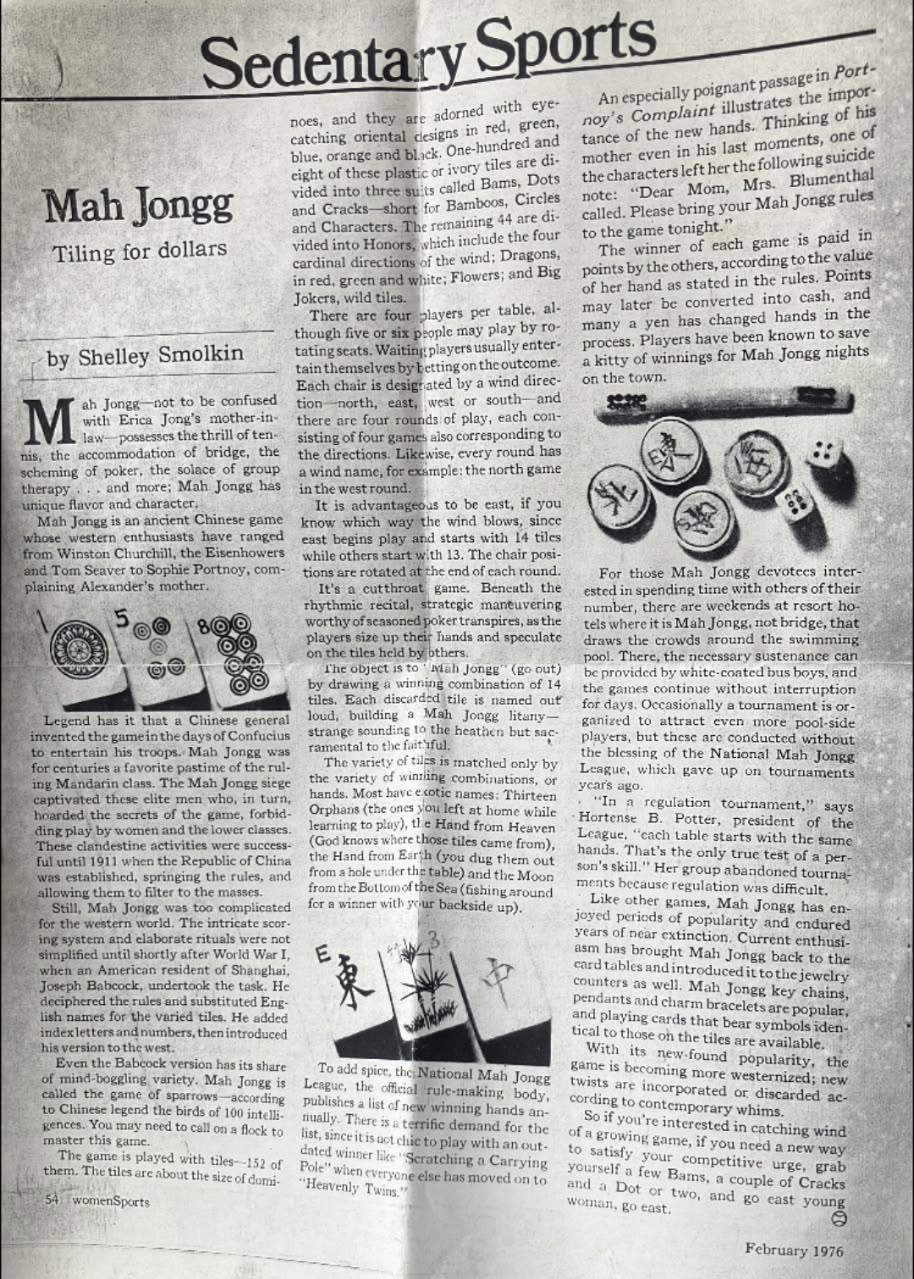
The game is played with tiles—152 of them. The tiles are about the size of dominoes, and they are adorned with eye-catching oriental designs in red, green, blue, orange and black. One-hundred and eight of these plastic or ivory tiles are divided into three suits called Bams, Dots and Cracks—short for Bamboos, Circles and Characters. The remaining 44 are divided into Honors, which include the four cardinal directions of the wind; Dragons, in red, green and white; Flowers; and Big Jokers, wild tiles.

There are four players per table, although five or six people may play by rotating seats. Waiting players usually entertain themselves by betting on the outcome. Each chair is designated by a wind direction—north, east, west or south—and there are four rounds of play, each consisting of four games also corresponding to the directions. Likewise, every round has a wind name, for example: the north game in the west round.

It is advantageous to be east, if you know which way the wind blows, since east begins play and starts with 14 tiles while others start with 13. The chair positions are rotated at the end of each round.

It's a cutthroat game. Beneath the rhythmic recital, strategic maneuvering worthy of seasoned poker transpires, as the players size up their hands and speculate on the tiles held by others.

The object is to “Mah Jongg” (go out) by drawing a winning combination of 14 tiles. Each discarded tile is named out loud, building a Mah Jongg litany—strange sounding to the heathen but sacramental to the faithful.

The variety of tiles is matched only by the variety of winning combinations, or hands. Most have exotic names: Thirteen Orphans (the ones you left at home while learning to play), the Hand from Heaven (God knows where those tiles came from), the Hand from Earth (you dug them out from a hole under the table) and the Moon from the Bottom of the Sea (fishing around for a winner with your backside up).

To add spice, the National Mah Jongg League, the official rule-making body, publishes a list of new winning hands annually. There is a terrific demand for the list, since it is not chic to play with an outdated winner like “Scratching a Carrying Pole” when everyone else has moved on to “Heavenly Twins.”

An especially poignant passage in Portnoy's Complaint illustrates the importance of the new hands. Thinking of his mother even in his last moments, one of the characters left her the following suicide note: “Dear Mom, Mrs. Blumenthal called. Please bring your Mah Jongg rules to the game tonight.”

The winner of each game is paid in points by the others, according to the value of her hand as stated in the rules. Points may later be converted into cash, and many a yen has changed hands in the process. Players have been known to save a kitty of winnings for Mah Jongg nights on the town.

For those Mah Jongg devotees interested in spending time with others of their number, there are weekend resorts, hotels where it is Mah Jongg, not bridge, that draws the crowds around the swimming pool. There, the necessary sustenance can be provided by white-coated bus boys, and the games continue without interruption for days. Occasionally a tournament is organized to attract even more pool-side players, but these are conducted without the blessing of the National Mah Jongg League, which gave up on tournaments years ago.

“In a regulation tournament,” says Hortense B. Potter, president of the League, “each table starts with the same hands. That's the only true test of a person's skill.” Her group abandoned tournaments because regulation was difficult.

Like other games, Mah Jongg has enjoyed periods of popularity and endured years of near extinction. Current enthusiasm has brought Mah Jongg back to the card tables and introduced it to the jewelry counters as well. Mah Jongg key chains, pendants and charm bracelets are popular, and playing cards that bear symbols identical to those on the tiles are available.

With its new-found popularity, the game is becoming more westernized; new twists are incorporated or discarded according to contemporary whims.

So if you're interested in catching wind of a growing game, if you need a new way to satisfy your competitive urge, grab yourself a few Bams, a couple of Cracks and a Dot or two, and go east young woman, go east.