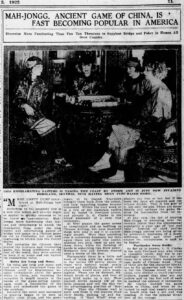
THIS EXHILARATING PASTIME IS TAKING THE COAST BY STORM AND IS JUST NOW INVADING PORTLAND. SEVERAL SETS HAVING BEEN PURCHASED HERE.
“Mrs. Umpty Uump entertained at Mah-Jongg last night.”
According to the prophets this is a new line which will shortly begin to appear in society columns or to be heard in conversation. Mah-Jongg, more fascinating than fan-tan and threatening to knock the foundation from under the long useful and entertaining games of bridge and poker, is a Chinese game as old as Confucius, but just now beginning to trickle into the United States.
For centuries the Chinese have played the intricate and interesting game, but, being indifferent to the rest of the world, they were content to keep it at home and not exploit its commercial value.
Rules Are Long and Many.
Its rules are long and many and had never been translated from the Chinese until an Englishman became enthusiastic about the game while in China, and, realizing the reception it would receive in the hands of the game-loving Americans, made a translation of the rules and introduced the game to the occident.
Recently the novel sets necessary to playing began to be seen in Pacific coast cities, and the game began to be played. Travelers brought them back from the orient, and then importing houses became interested. Within the next week or so a few of the elaborate outfits will be found in Portland stores, and already L. G. Clarke is the proud possessor of a very fine equipment.
At first glance the game seems as complicated and as baffling as Chinese writing, but once mastered those who play it say it is exceedingly simple. More than anything else it resembles dominoes, but then again there are parts like casino, wherein you pick them up and lay them down, while the farming of hands is something like draw poker. Moreover fate and fortune depend upon a throw of the dice.
Fortunately there is a little red book of rules with the game, else to the novice 136 pretty pieces of ivory with bamboo backs, neatly carved and skillfully designed with characters, would seem quite meaningless. There are 34 distinct, different kinds of pieces, and four of each kind make up a set. Four players divide equally 136 of the little plaques and roll the dice for the advantageous position of “East Wind.” Then the Chinese wall is built and from it the players draw their hands, picking up and discarding. If “East Wind” wins all players pay him or her, but if she loses she pays all players and the winner double. That is the gist of it, but only the gist. There are many details, and perhaps the game derives its fascination from its intricacy.
At any rate, the fad of playing Mah-Jongg is sweeping over the country faster than the phenomenal popularity a year ago of “put and take.” Instead of card parties Mah-Jongg parties are being given by prominent hostesses of a dozen different cities, and after each seance the enthusiasm is said to be higher.
Portlanders Own Outfit.
So far as is known, L. G. Clarke is the only Portland man who owns a complete outfit, and his is exceedingly elaborate. There are six trays in a novel little brass-bound case made of Chinese wood. Four of them are for the character blocks, one is for accessories and the other is for the Chinese brand of poker chips, very similar to small cigarette holders, except that they are not hollow and on the flat end of each is marked the amount it represents.
Mr. Clarke learned the game while in China, and when he returned he said that nearly everyone on board ship had a set and was playing. It was the popular diversion of the voyage.
Transcription note: Text follows the visible clipping; a few words may be uncertain because of the scan quality.